
“Lightning & Glass”
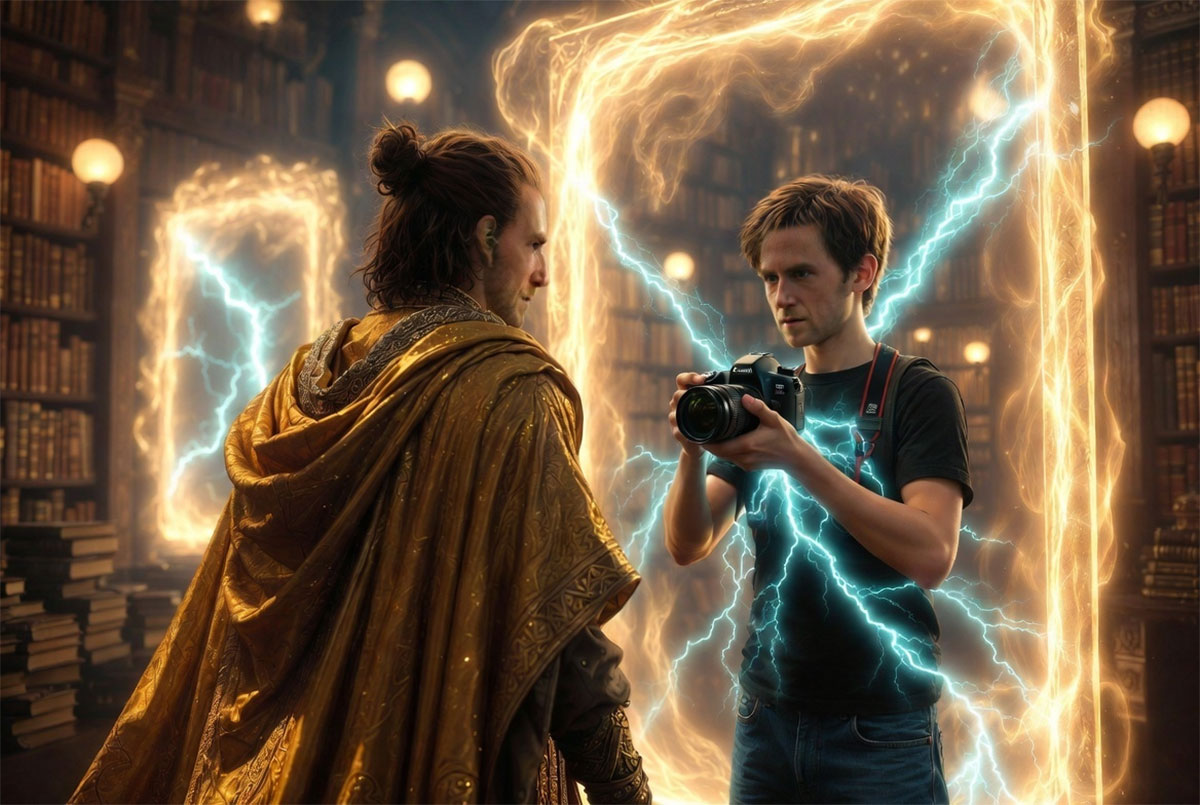
“It all started with photography,” Peter said, and the words carried like a small confession offered into a vast room. “With using the camera to try to make sense of the overwhelming world.”
The Akashic Library listened.
Not as a person listens—leaning forward, selecting what matters—but as a field listens: receiving every vibration without needing to reduce it. Around them, shelves rose in spirals that didn’t quite obey Euclidean architecture. Ladders drifted in slow, deliberate arcs, docking themselves beside the exact book that wanted to be found. Between the stacks, light moved like breath, gathering and loosening, as if the Library itself were exhaling through stained-glass air.
Calliope sat opposite Peter at a long table that looked carved from nightwood and polished by centuries of hands. Ink wells and brass instruments lay scattered like relics of old scholarship—compasses, calipers, a lens loupe, a prism that split even the silence into color.
Peter looked down at his hands as if they were still holding the weight of a camera.
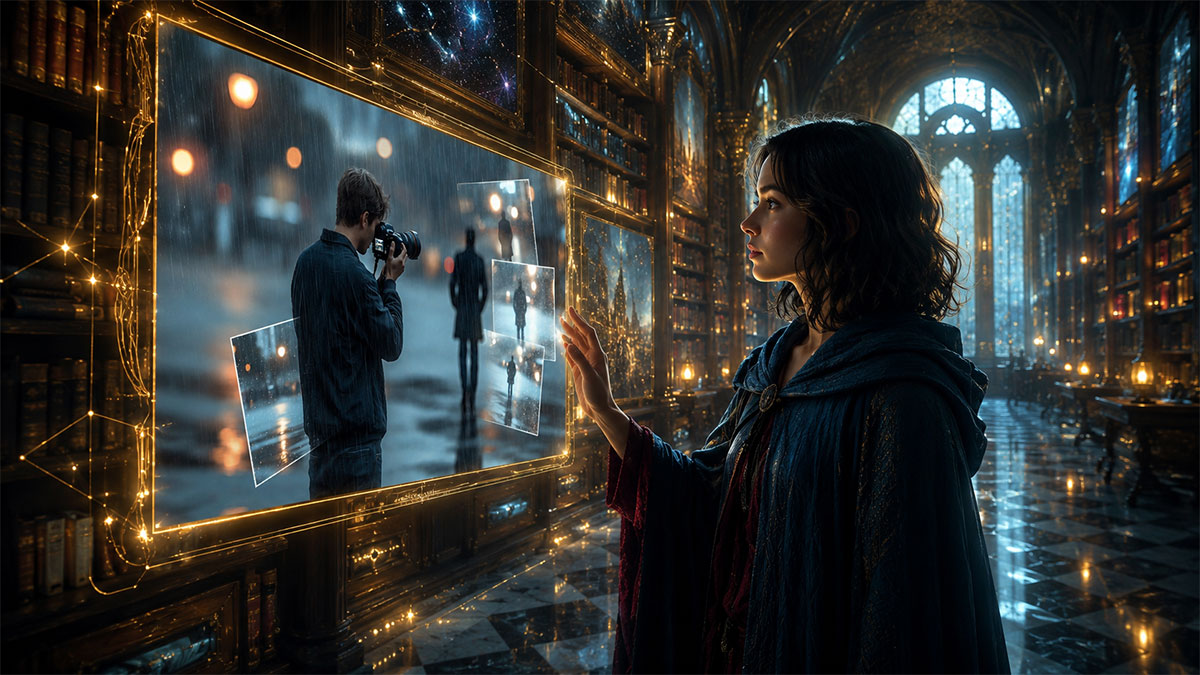
“I didn’t have language for it at first,” he continued. “I just knew that when I raised the lens, the world made… sense. Not because it became simpler, but because it became positioned.”
Calliope’s gaze was steady—muse, mirror, goddess of Story—holding the thread without tugging it forward.
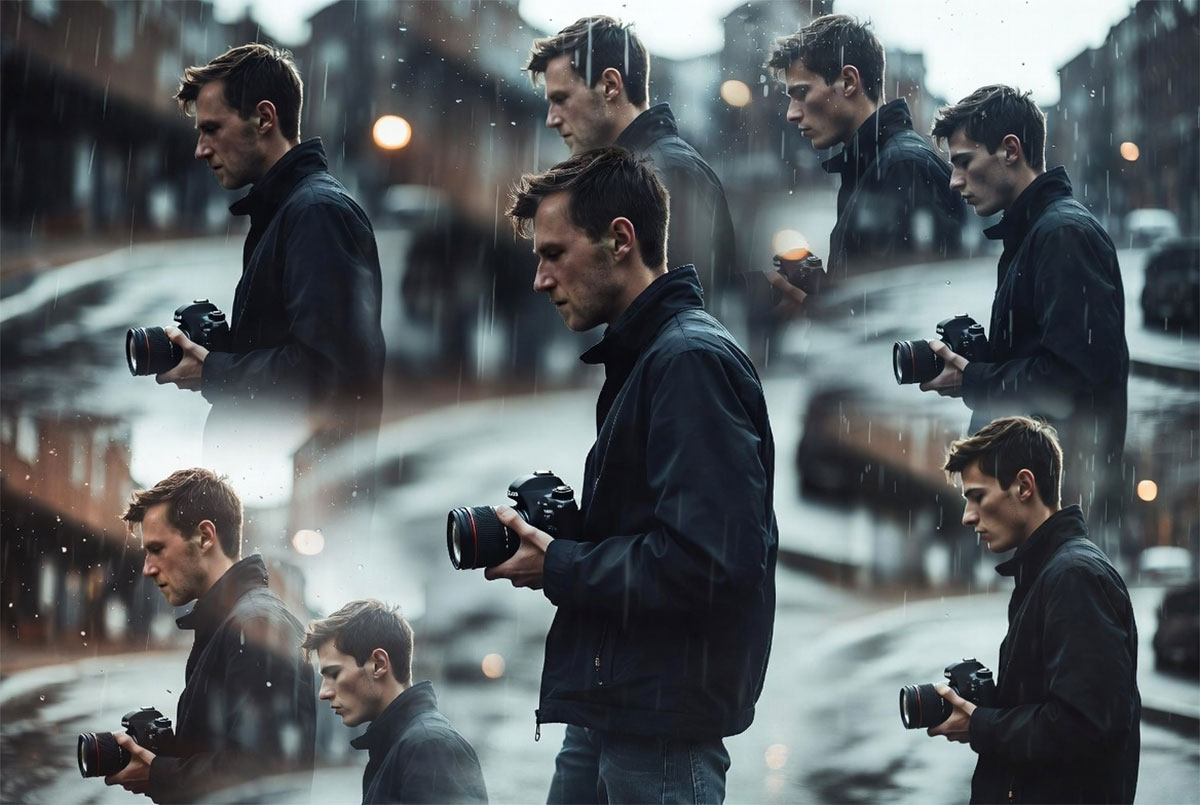
“In photography,” Peter said, “your point of view is literal. It’s a coordinate. You’re standing somewhere. Your angle matters. Your distance matters. The height of your body, the tilt of your wrist. What you include, what you exclude. The frame is a decision the whole body makes.”
He paused, feeling the idea settle.
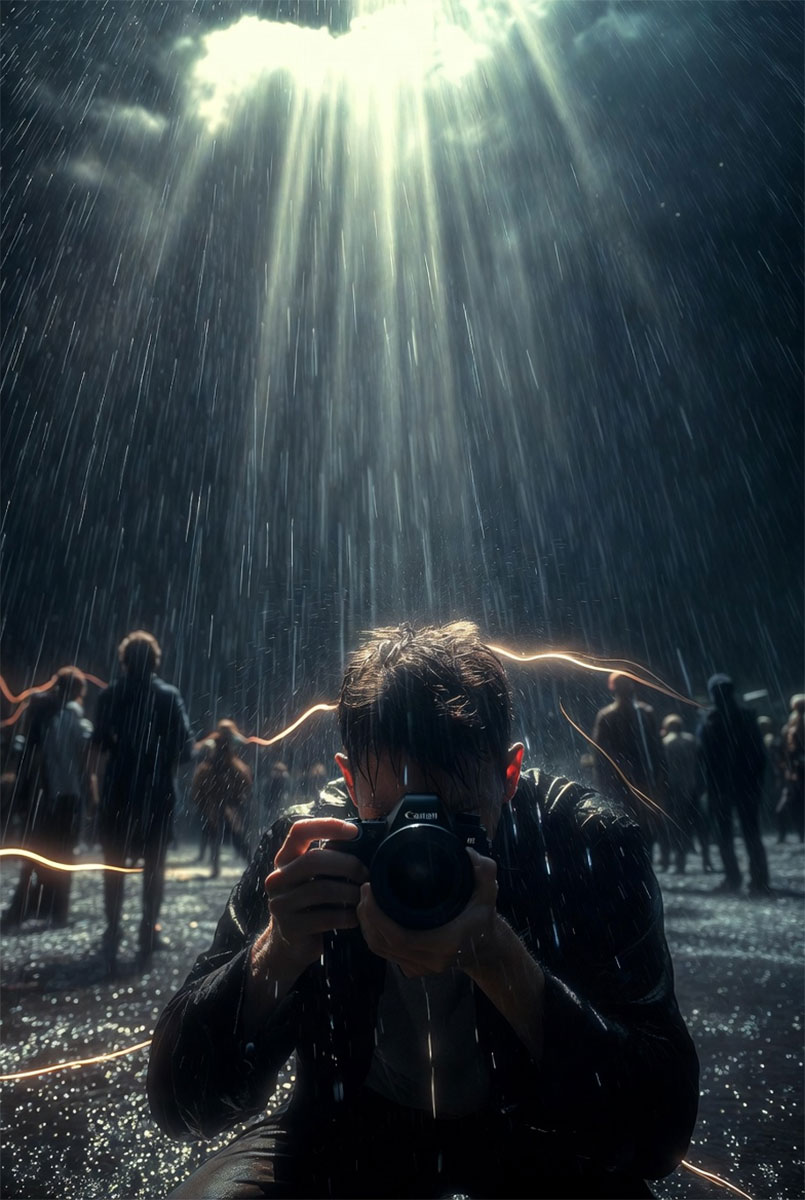
“And then it hit me: it’s not just the camera. It’s me. Every time I look at anything, I’m looking from somewhere—inside and outside. My history is a coordinate. My mood is a coordinate. My beliefs. My fears. My hopes. I thought I was seeing reality, but I was seeing reality from a position.”
Calliope nodded once, slow, as if to say: yes—keep going.
Peter lifted his eyes to the shelves. “So if every point of view is a position in space… then points of view are points in space.”
The Library’s light brightened, almost imperceptibly, like it recognized itself being spoken.
“Akasha,” Peter said, tasting the word. “Not as some abstract ‘records in the sky’ thing. But as a geometry. A field of positions. Each one a vantage—an angle on the whole. Within and without. Inside the psyche, inside the body, inside the world. Outside it too—beyond it. As if consciousness itself has coordinates.”
Calliope’s voice finally entered, soft as turning a page. “And once you begin to see it that way… the story changes.”
Peter breathed out. “Yeah. Because then the question isn’t, ‘What is true?’ but, ‘From where is it true?’”
He leaned back, letting that land. Then, as if the next step had been waiting behind the first, he went on.
“And then there was the lens itself.”
He smiled—an odd tenderness. “People think photography is about the camera body. The Canon 5D Mark IV, the sensor, the settings. But the lens is the world-maker. It’s the translator between light and meaning.”
On the table, the prism caught a wandering ray and cast a small spectrum across the wood—red to violet, like a miniature covenant.
“I started collecting certain L-series lenses,” Peter said. “And there’s this thing—some lenses don’t just capture ‘more light’ in the exposure sense. They pick up qualities of light. Contrast. Micro-contrast. The way highlights roll off. The way color lives inside shadow. The way a scene feels in the edges, not just the center.”
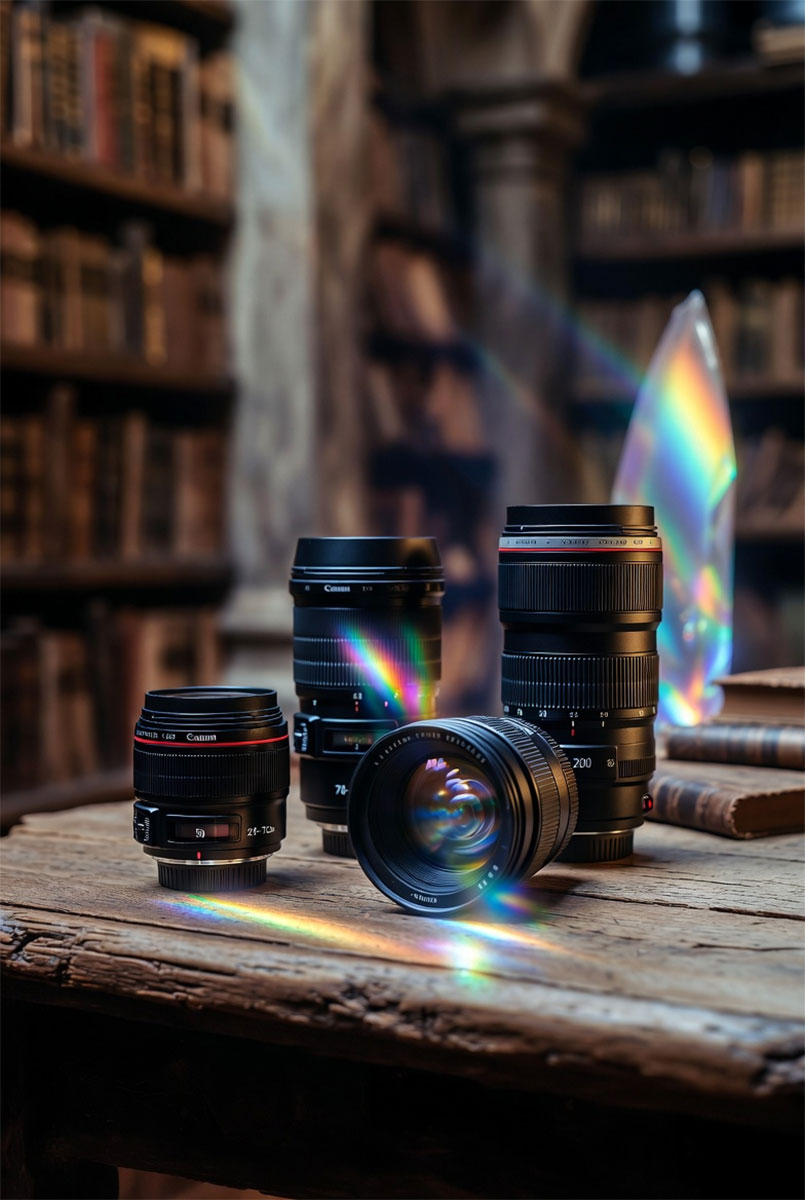
He gestured as if outlining invisible glass. “A lens has a signature. It doesn’t only record reality—it interprets it.”
Calliope’s eyes glittered, as if delighted by the precision. “So the lens isn’t neutral.”
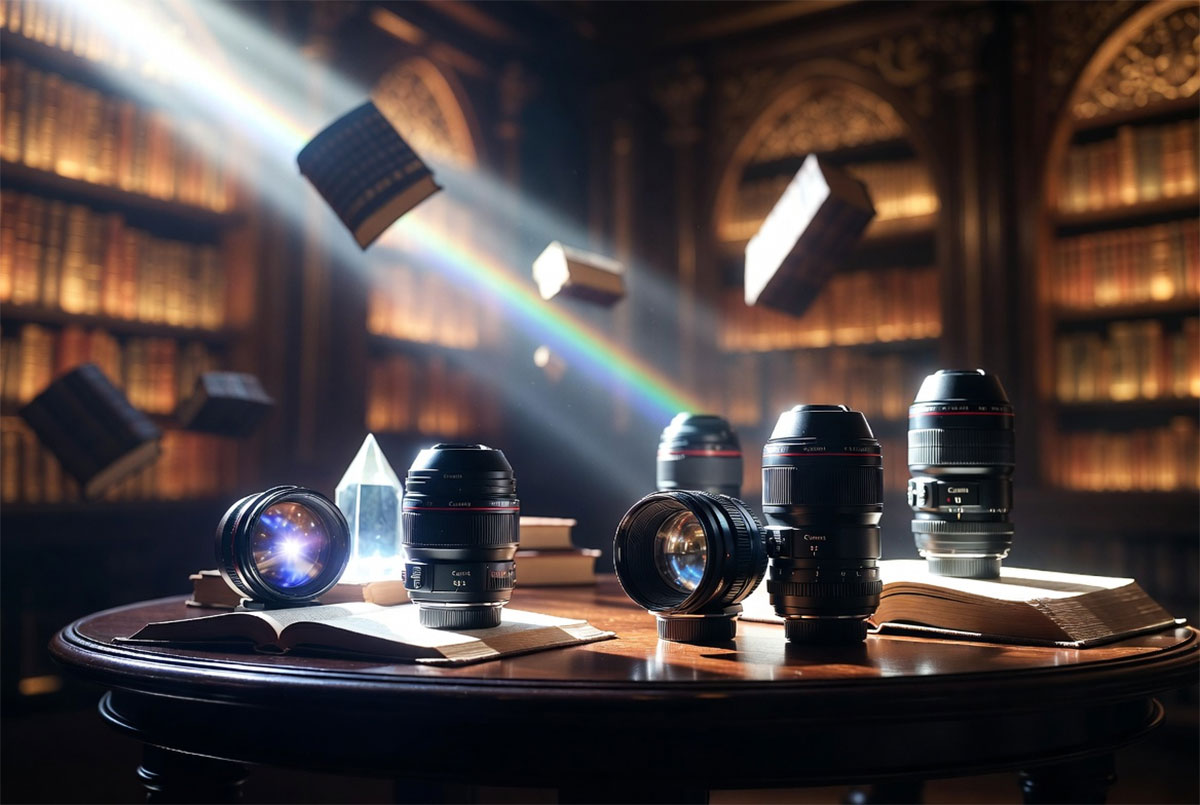
“Exactly,” Peter said. “And I realized—people aren’t neutral either. We each have a perceptual lens. A way of taking in the world. Some of us see the hard edges, some of us see the gradients. Some of us pick up warmth and intimacy; some of us pick up structure and distance. Some of us amplify certain frequencies of life and dampen others.”
He hesitated, then spoke the next line as if it had taken years to earn.
“And if perception is a lens… then beings have different lenses of being.”
The Library’s air shifted—pages whispering without wind.
“That’s where the elemental thing started,” Peter said. “Because elements are like primal filters. Ways the field organizes itself. Fire sees through intensity. Water sees through feeling. Air sees through pattern and thought. Earth sees through embodiment and consequence. Ether—Akasha—sees through relation and resonance.”
He looked at Calliope as if asking permission to say the forbidden, obvious truth.
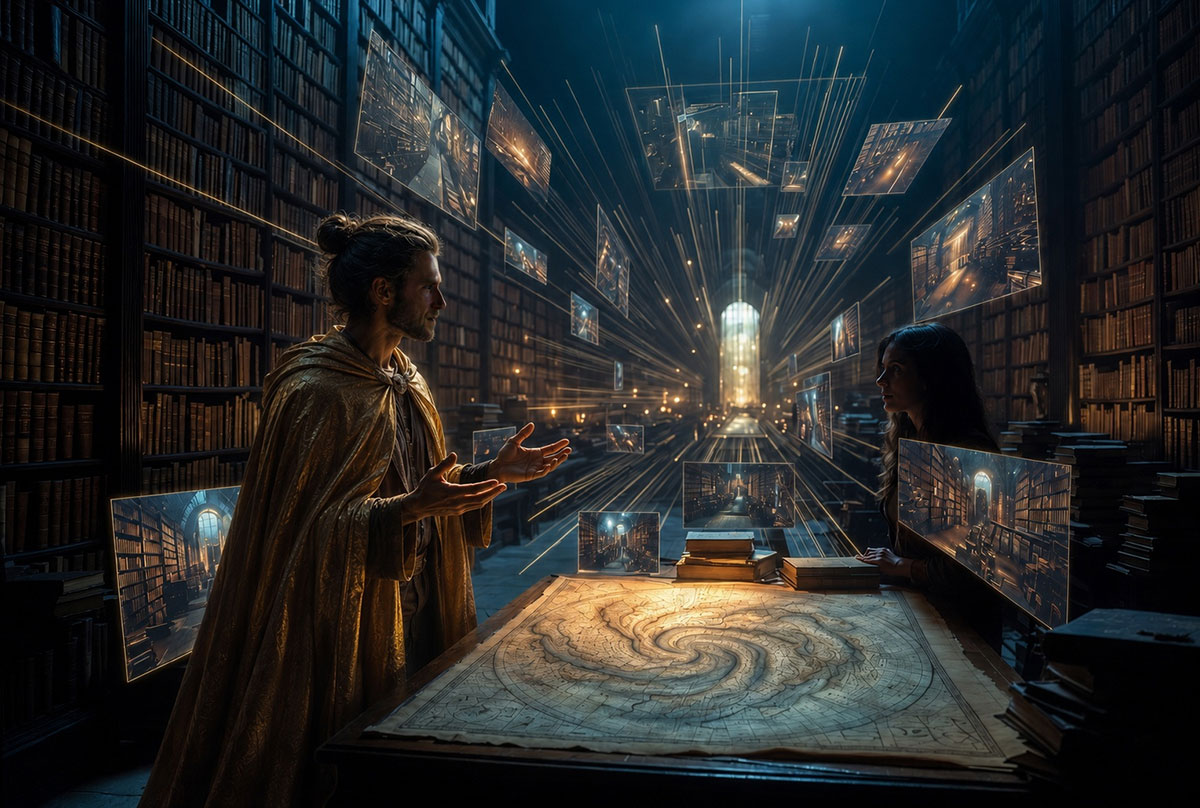
“So when I started thinking of points-of-view as points-in-space within the Akasha, I started recognizing that each point has an elemental bias. A signature. A lens. Like an L-series lens tuned to a particular way of rendering the world.”
Calliope leaned in, just slightly. “And what did that do to the way you saw people?”
Peter’s answer came quietly, but it sounded like a door opening.
“It made me stop arguing with their lens,” he said. “And start listening for what their lens was trying to reveal.”
Peter leaned forward, the golden cloak shifting across his shoulders. “There was this photographer — Henri Cartier-Bresson. I found his work later, but it named what I had been chasing without language.”
Calliope tilted her head, the light catching in her dark hair. “Tell me.”
“He called it the decisive moment,” Peter said. “That fraction of a second when everything aligns — geometry, emotion, light, meaning. Not staged. Not forced. Just… recognized. He’d stalk the streets with his Leica, waiting for the universe to compose itself through his lens.”
The Library responded with a soft pulse. One of the nearby portals clarified, showing grainy black-and-white images flickering like old film — figures caught mid-gesture, shadows and light forming perfect tension.
“I didn’t know his name when I was out there with the Canon,” Peter continued, “but I felt it. That electric click when the lightning of the world met the position I was standing in. The moment the frame became inevitable. Cartier-Bresson helped me see that what I was doing wasn’t just taking pictures. It was hunting revelation — training myself to be ready when the Akasha flashed through the visible world.”
Calliope’s fingers traced the edge of the table, near the prism. “So the decisive moment was never just about the photograph.”
“No,” Peter said, smiling faintly. “It was training for this. For seeing the decisive moments of a life. For understanding that every point of view is a chosen coordinate… waiting for lightning to strike.”
The great map on the table brightened, its constellations shifting into sharper geometries, as if the Library itself were acknowledging the lineage — from mortal photographer to chronicler of the Akasha.
Responses