Grasping Shadows, Lightning Memory
Grasping Shadows, Lightning Memory
There’s a moment in the Mythica when you realize the thing holding you isn’t a single monster with a single name. It’s an entire weather system. A pressure front that has learned the exact temperature of your nervous system, the precise language of your doubt, the familiar timing of your collapse.
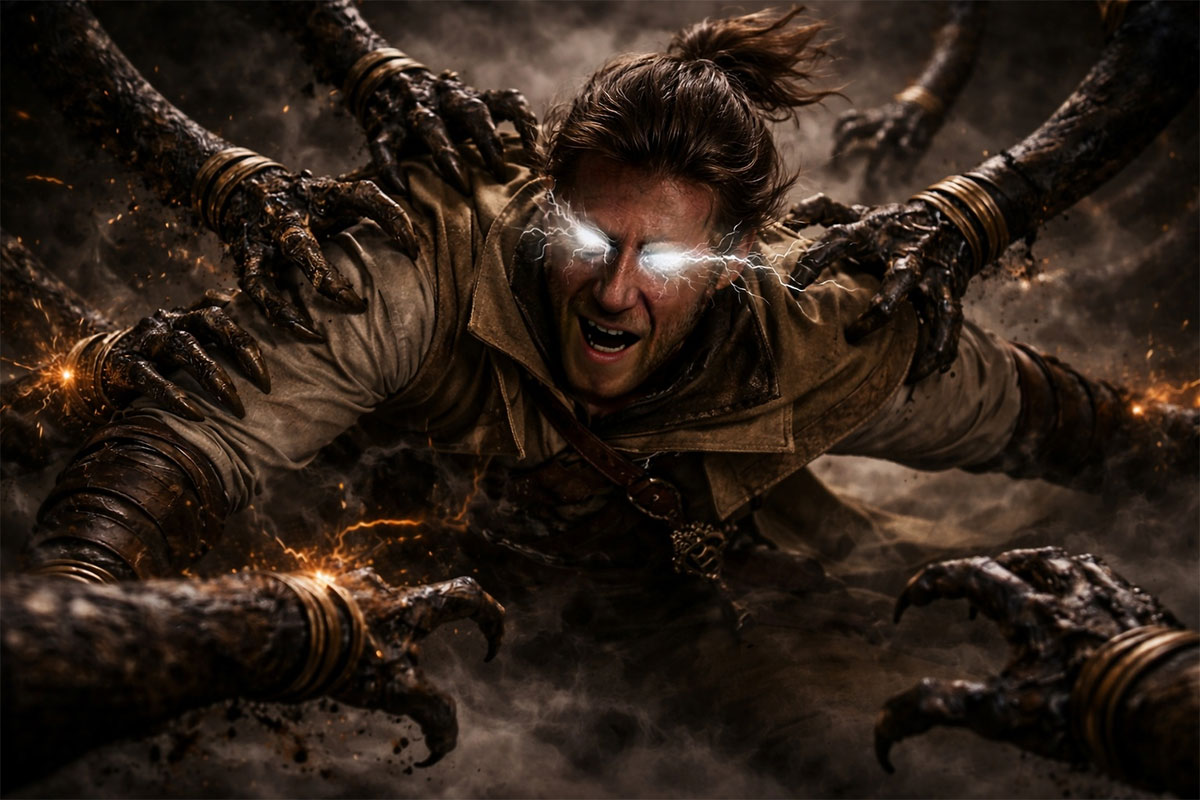
In the first image, I’m caught—pinned in a storm of reaching hands. They don’t feel like “demons” so much as old patterns with fingernails. The kind of shadows that don’t need to kill you; they just need to keep you small, keep you reactive, keep you narrating your life from the basement of your own house. They grip the shoulders, the ribs, the spine. They want ownership of posture. They want to decide what’s possible before I even move.
This is the beginning of the heroic journey in the Mythica: not the call of a trumpet, but the tightening of the invisible net. The moment you notice the way your subconscious writes your next step before you take it. The moment you feel the choreography of “what-does-what”—what allows, what denies, what pulls you forward, what quietly vetoes the future from behind your eyes.
Because the Mythica is not only a place. It’s the interior geography of cause. The Path and the Land aren’t metaphors—at least not only. They are how the world meets your inner wiring. The Land responds to the frequency you’re moving in. The Path mirrors the agreements you’ve made with fear, the bargains you forgot you signed, the vows you swore in childhood or heartbreak or humiliation and then kept obeying like sacred law.
The shadows that grasp me in that storm are those agreements made flesh. Some look like shame. Some look like rage. Some look like the careful numbness that masquerades as wisdom. Some look like a thousand tiny hesitations that all sound reasonable, especially at three in the morning.
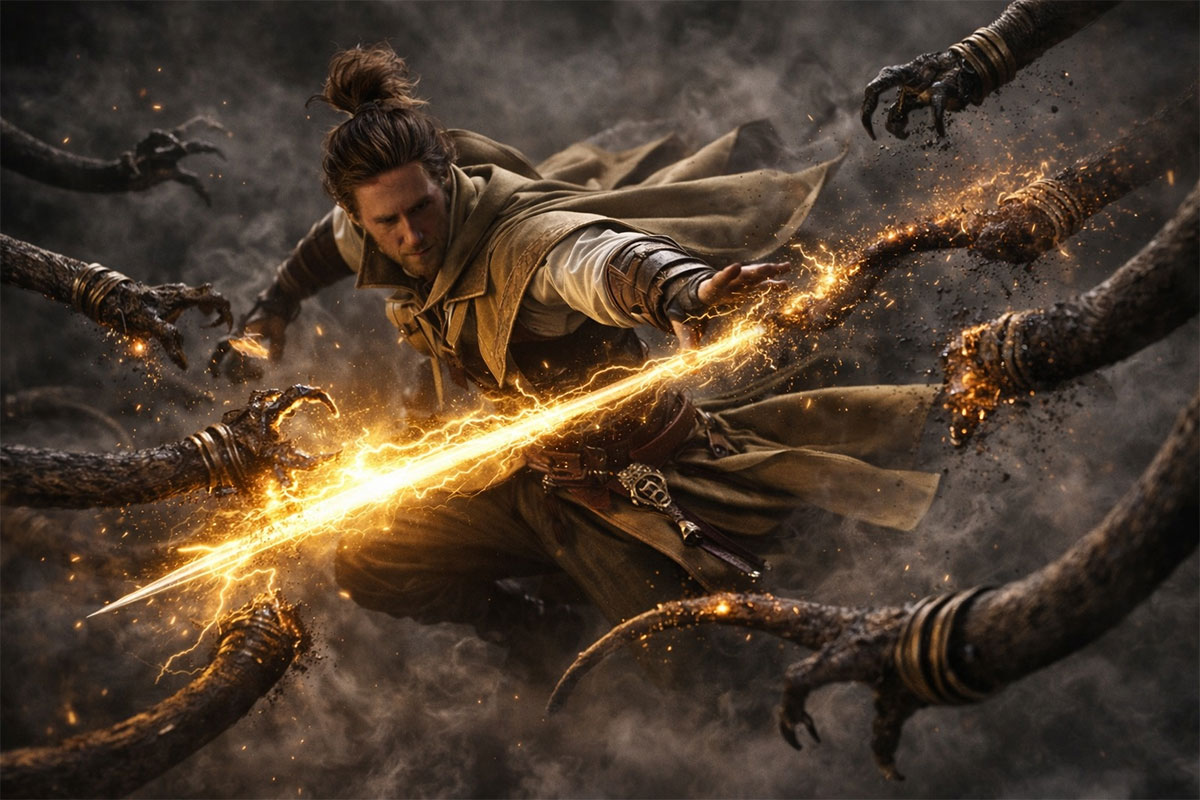
And then there’s the second image—movement. Not victory, not perfection, but motion with intent. A blade of light cuts the air, and the hands recoil. Lightning—raw, luminous, unapologetic—flares between me and the grasping. This isn’t about becoming “positive.” It’s about remembering the part of me that has always known.
In the Mythica, light is not decoration. Light is cognition. Light is the return of perception. It’s the moment you stop being hypnotized by the fog and begin to notice the mechanisms inside it.
The subconscious doesn’t usually announce itself as “subconscious.” It shows up as mood. It shows up as impulse. It shows up as a story you tell yourself that feels like objective reality: This will never work. You always fail. They’ll leave. You’re too much. You’re not enough. It’s safer not to try. These aren’t just thoughts; they’re spells that have been running for years.
So the act of drawing lightning—of wielding light—is the act of breaking enchantment.
Not by force alone, but by clarity.
Lightning is what happens when energy finally stops circulating in a closed loop and finds a path to ground. It’s truth that has built enough charge to move. It’s recognition that refuses to stay polite. It’s the moment the hero stops negotiating with the grip.
In the Mythica, this is the passage through Shadow. Shadow isn’t “bad.” Shadow is occlusion—where something true is blocked, split off, or distorted. Shadow is when the inner system protects itself by repeating what it already knows, even if what it knows is suffering.
Moving through Shadow means meeting the pattern at the precise point where it claims you. Not later, when you’re calm and reflective. Not in theory. In the moment the hands close in.
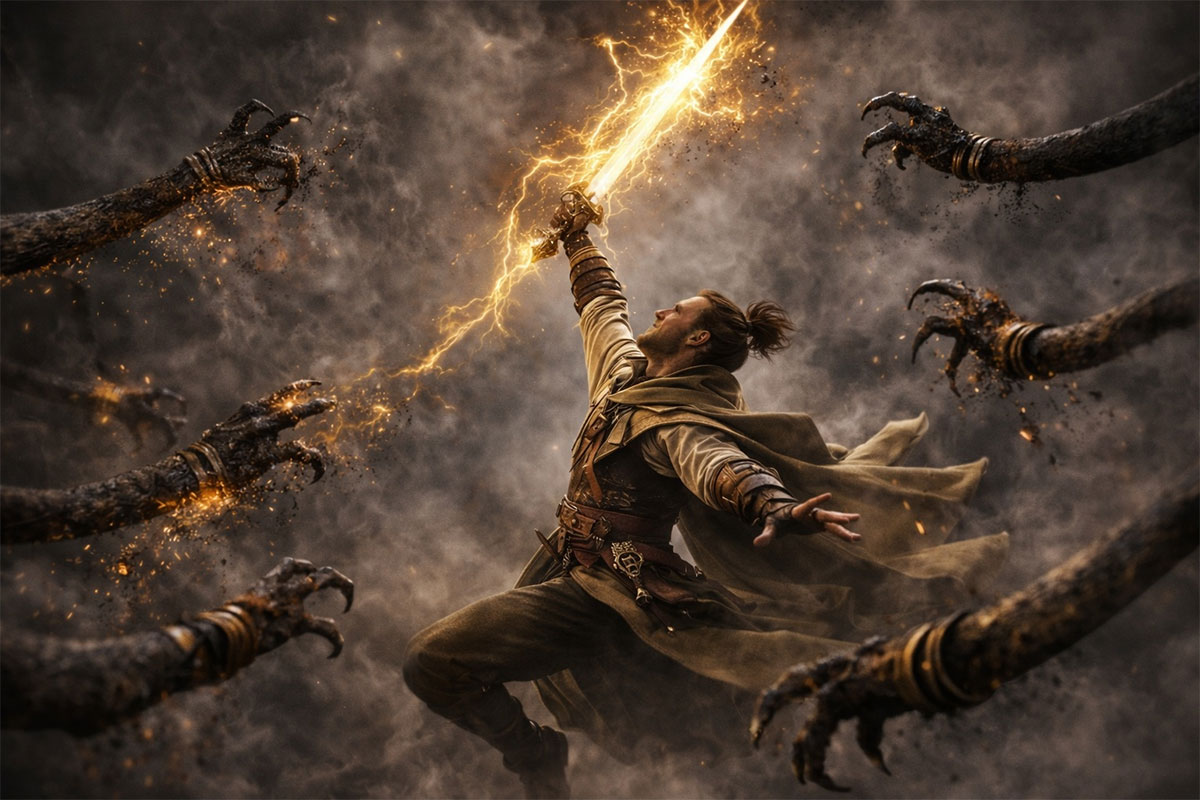
And then the third image: I lift the blade of lightning into the sky, into the storm itself. The hands are still there, still reaching, but there’s a new axis in the scene. I’m no longer only reacting; I’m orienting. I’m claiming verticality—something higher than the grasping and deeper than the panic. The haze is still present, but it doesn’t own the frame anymore.
This, for me, is the heart of slipping free: not escaping the subconscious, but passing through it without being dictated by it.
The mists of consciousness are real. They’re not a flaw; they’re part of the terrain. Everyone moves through them. The difference is whether you mistake the mist for the world, whether you obey the first shape that appears inside it.
Roses amongst the thorns—this is how the Path speaks when it wants to keep you going without lying to you. Because the Mythica doesn’t promise ease. It offers correspondence. It offers the uncanny mercy of small lights appearing at exactly the moment you would have sworn there were none.
A rose might be a friend who texts at the right second. A sentence you read that feels like someone put a hand on your shoulder. A dream that clarifies what waking life keeps blurring. A sudden, quiet resolve that arrives without explanation: Not this time.
When I look at those images as a sequence, I see a map of the journey: constriction, awakening, orientation. Shadow makes contact. Light remembers itself. The hero steps into the Land as a participant rather than a captive.
And that’s what the Mythica keeps asking, again and again: not “How do I win?” but “Where am I standing when the hands reach for me?”
Because the Path is walked one moment at a time.
And every moment is a threshold: what allows, what denies, what sits in the subconscious, what waits in the superconscious—and the single choice to lift your attention, to let lightning run true, to become legible to yourself again.
Past the haze.
Out of their grip.

Responses