
sacred places
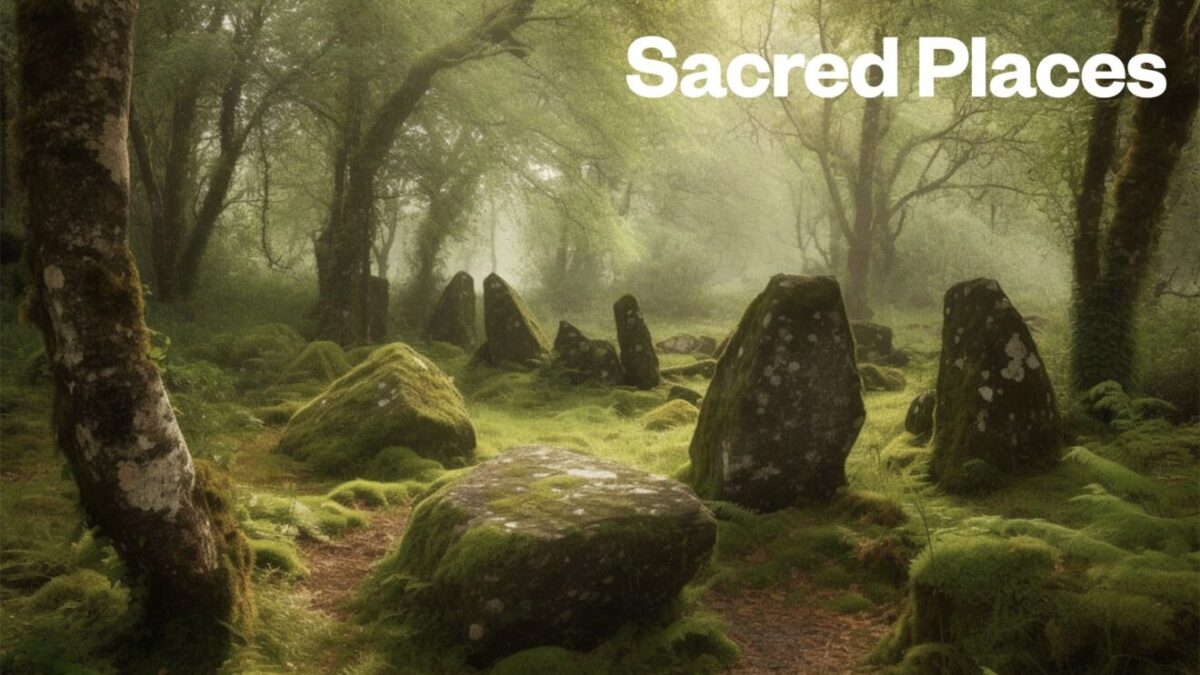
There are places on this earth where the veil is thin. Where the land remembers something older than human civilization, and that remembrance speaks directly into the subtle body of whoever arrives with enough openness to receive it. Sacred places are locations in the coordinates of consciousness where the vibrational substance of the earth is clean, potent, and radiant — where the ley lines of the World Tree converge and the Great Dragon's elemental intelligence surfaces most powerfully into the perceptible dimensions of the terrasphere, creating conditions uniquely favorable to the transformation of consciousness and the deepening of one's relationship with the telos. They are the nexus points of the subtle earth where the distance between the ordinary surface experience and the deeper dimensions of the mythosphere, mnemosphere, and akasphere becomes most traversable, and where the practitioner of the subtle arts can most readily access the underlands with which their particular heroic journey is engaged.
The existence of sacred places is recognized across every culture and tradition that has maintained a living relationship with the intelligence of the land. The great pilgrimage sites of the world — Mount Kailash, Glastonbury, Mount Shasta, Machu Picchu, Jerusalem, the great temple complexes of Egypt and Mesoamerica, the stone circles of northern Europe — have drawn seekers from across all traditions not merely because of their historical or cultural significance but because of the genuine quality of elemental potency they embody. These are places where the World Tree surfaces most powerfully into the material plane, where the intelligence of Gaia speaks most directly to the subtle body of the practitioner who comes in genuine openness to receive. The pilgrims were not seeking a symbol. They were seeking contact. And they found it.
The full spectrum of sacred places extends beyond these well-known planetary power points to include the infinitely varied landscape of individually significant locations that emerge along any given practitioner's personal timeline. The specific places where one has undergone genuine initiations, where significant kairos encounters have occurred, where the synchronicities have been most concentrated and most legible, where the inner field has most unmistakably responded to the quality of the outer landscape — these are sacred places in a profoundly personal sense, coordinates in the akasha where this particular soul's story has touched the land most deeply. The sacred geography of one's own heroic journey is inseparable from the sacred geography of Gaia herself, for they are, as the Mythica insists, different aspects of the same living reality.