principles of myth
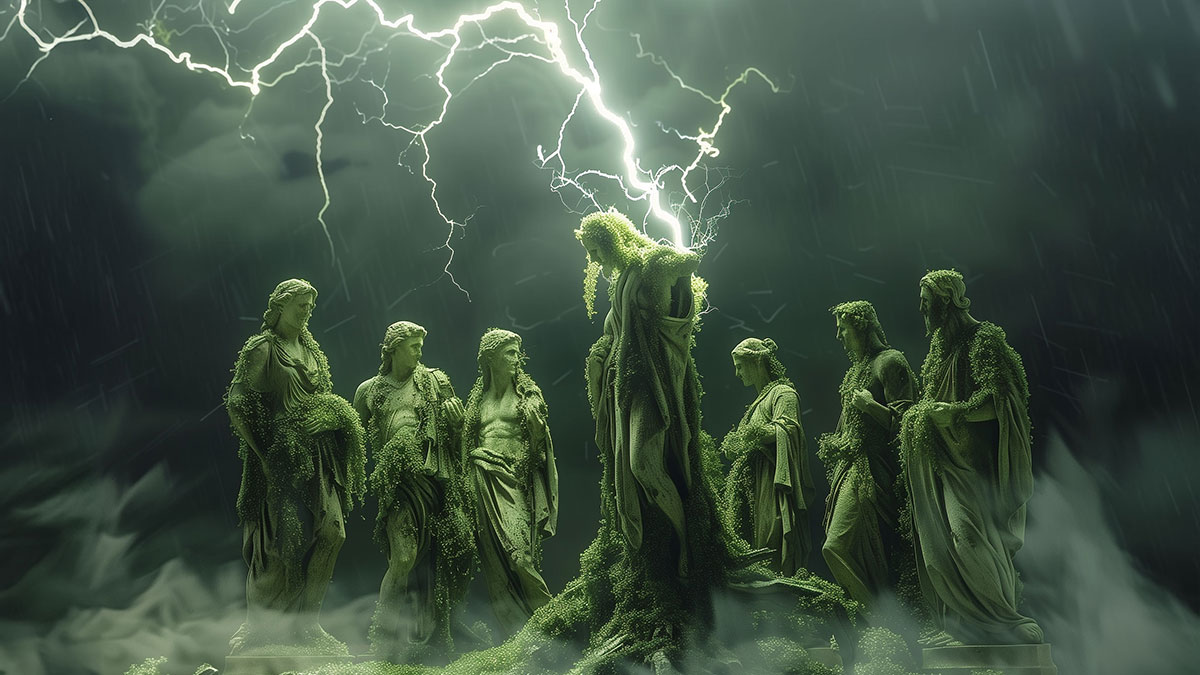
Every story that has ever moved a human heart is made of the same bones. The principles of myth are the fundamental structural laws that govern the shape and movement of the heroic journey — the universal patterns operative in every story, every life, and every encounter with the Great Story's intelligence, regardless of the specific cultural context, individual character, or particular chapter of the timeline in which they appear. In the Mythica's cosmological framework, these principles are understood as ten in number — ten structural currents inside story itself, the physics of myth. They are: Theos, Logos, Eros, Kairos, Mystos, Mythos, Pathos, Ponos, Telos, and Ethos. They are not separate concepts but ten dimensions of a single living reality: the intelligence of the Great Story expressing itself through the full spectrum of a human life. A life does not graduate from one and leave it behind — it returns to the same forces repeatedly, each time with different degrees of clarity, distortion, or maturity. These ten principles form a circle rather than a ladder — a labyrinth with ten stones that every human thread touches over and over.
Each of the ten principles illuminates a specific dimension of the heroic journey's structure. Theos is the living undivided Presence beneath all apparent separation — the source field inside which every story, however isolated it feels, takes place. Logos is the principle of structure and meaning — the deep grammar of worlds, the rational intelligence through which the patterns of the Great Story are understood and articulated. Eros is the principle of love and relational magnetism — the current of attraction that draws souls toward connection, coherence, and care; the force that makes anything matter at all. Kairos is the principle of sacred timing — the recognition of the qualitative dimension of time in which certain moments are ripened and open, not forced. Mystos is the principle of sacred unknowability — the irreducible mystery, the unknown and the initiatory, the threshold dimensions that exceed rational comprehension and protect myth from being flattened into method or explanation. Mythos is the living story itself — the meaning-bearing weave of symbols, archetypes, and repeating patterns that give events significance across the full arc of a life. Pathos is the principle of emotional reality — the felt texture of being human: grief, joy, absurdity, tenderness, the emotional taste of the journey while larger patterns unfold. Ponos is the principle of embodied effort — the labor of incarnation: survival, trauma, work, maintenance, endurance, and the ordinary burdens that make vision real in matter. Telos is the principle of direction and destiny — the aim of the story, the encoded trajectory within a life-thread, the pull toward deeper coherence. And Ethos is the principle of character and stance — the way one stands inside the whole thing: one's manner, code, bearing, and quality of participation in what happens.
These ten principles are not moral achievements but structural presences encountered repeatedly along the spiraling corridors of the Labyrinth of Life. The heroic journey unfolds within a specific destiny — a set of karmic conditions and soul agreements that constitute the given landscape of one's particular myth — while simultaneously involving genuine creative agency. Fate provides the terrain; Fortune is what the practitioner makes of it through the quality of engagement. The principles of myth are the fundamental intelligences that govern how that engagement most skillfully and authentically unfolds. To know these principles is not to escape the mystery of the story. It is to walk into it with eyes open.